Reclaiming Resiliency: Nature’s Wisdom
Finding a way forward in the steady winds of systemic oppression
I admit–I am a dendrophile. I love trees. When I was little I remember reading Jean Craighead George’s On the Far Side of the Mountain —where the main character finds a tree to live in that was struck by lightening and burnt from the inside, yet still firmly alive. I read it over and over, dreaming of a day I too could live inside a tree.
That memory popped up this week when I was researching the oak dieoff we are experiencing here in central PA (and many of the Mid-Atlantic forests are struck by it, too). In my research, I learned about the resiliency of oaks and how they are compromised. One of the biggest learnings was about heartwood, the inner layer that is dead inside trees, that are its backbone and, in oaks, strong as steel.
The funny thing is, though, is that oaks have evolved to live without their heartwood. The heartwood is sometimes devoured by fungus or disease, as in that mighty oak-home in that childhood book, yet it doesn’t harm the tree–as the living tissue surrounds.
It made me think more deeply about how burnout is when our heartwood is exposed, and against our agency parts of us are devoured. The good thing, tree wisdom tells us, is that that wood was dead anyway.
Strength doesn’t just happen because we have the most firm core and deepest roots. Strength comes because we can weather the storm and can maintain our growth–our outer living tissue–despite the steady winds that buffer. When faced with systemic stress–we have systemic power of resiliency.
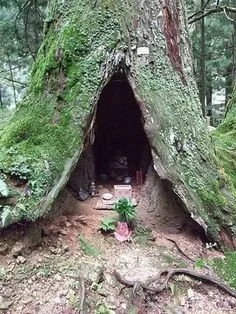
a little home built within a living tree
Resmaa Menakem says “Healing does not mean “going back” to the way things were. It means using the energy that survived the trauma to create something new.”
Indeed, these times are filled with collective wounding, and our resiliency is called upon not just personally but collectively. Most of us who are healers and helpers are aching at the state of the world. Burnout is a collective wound, a direct result of systems that extract, devalue, and silence. When the burnout we’re experiencing is systemic, the response needs to be deeper than self-care; it needs to be soulful care rooted in boundaries, justice, and a fierce commitment to what is truly ours to hold.
The Burnout Is Real—And It’s Not Just You
Many healers, helpers, educators, advocates, and everyday people are reckoning with an ache that goes beyond fatigue. It’s the exhaustion of living in systems that were never designed for our thriving—capitalism, white supremacy, ableism, patriarchy, extractive productivity cultures.
When we keep pushing ourselves to “do more” or “fix everything,” we mimic the very systems that chew at our heartwood.
So how do we stay awake and engaged, without burning out?
1. Name the System, Reclaim the Self as Part of Whole
Burnout thrives in isolation and shame. One of the most powerful tools of resistance is naming what’s happening. This exhaustion is not a personal failure. It is a signal. A symptom of deeper imbalance of care being usurped for commodity.
Once we name the root, we can separate our identity from our exhaustion. This is not about individual deficiency—it’s about recognizing that, just like the individual trees are sentinels of communication of threats in the surrounding ecosystem, our nervous systems weren’t built to process unending urgency and injustice alone.
2. Practice Fierce Boundaries with Love
Yes, we want to show up. Yes, we care deeply. But we are not meant to carry every part of it.
A key to surviving—and transforming—systemic burnout is discerning what is ours to do and what is not ours right now.
As activist and teacher adrienne maree brown says: “Move at the speed of trust. Small is good. Slow is good.”
Ask Yourself:
• What is mine to hold today?
• What can I release?
• Where am I over-functioning out of guilt, urgency, or fear?
Set a clear container for your activism, your caregiving, your presence. Then let that container hold you too.
3. Stay Engaged Without Indulging in Fear
Resisting oppression and participating in change doesn’t have to mean martyrdom. It means learning how to sustain your presence over time. When the system eats at your heartwood, trust your outer resiliency, and know that the hole that remains can become a place of opportunity for shelter.
This means pacing. It means rest. It means letting go of the belief that your worth is tied to your output or the urgency of the moment.
One of the richest experiences I’ve noticed for clients who are reclaiming their resiliency is rewiring their connection to community. I know this myself—when I allow mutual care, not individual sacrifice, be the rhythm of my movement through and within my life, I am much more able to be the kind of person I’m hoping to be—in my work, my relationships, and in the world.
4. Re-root in Collective Wisdom
When burnout feels systemic, we need more than solutions—we need solidarity. Healing in community allows us to see that:
• We are not alone in our overwhelm.
• We don’t have to hold everything ourselves.
• Our roles can be shared and fluid.
Return to ancestral rhythms, community-based practices, liberatory spirituality, and collective dreaming. The work of resistance isn’t new—it’s ancient, and we don’t have to do it alone.
5. Live into the Question: “How am I to be?”
Standing as an oak in the woods, you too have an ecosystem within you. The courage is in listening deeply enough to discern what your “something” is—without indulging in despair or inflating into saviorism. As Anne Lamott says, “help is the sunny side of control.”
For me, burnout always comes when I confuse my career, my family, my relationships with the true work of my soul.
When we lean into an understanding of what true resiliency is, that’s where we can know freedom. Boundaries are the beginning of self care.
May You Know Courage, May You Know Rest
You are not alone.
When you rest, you are not abandoning the cause.
You are remembering that your body, your soul, your time—are sacred.
Burnout will try to tell you that you’re failing.
Your soul is whispering something else:
You are allowed to live.
You are allowed to heal.
You are allowed to keep showing up—with a full heart and open hands.
Let’s keep choosing that kind of resistance, together.
Resources for the Journey
From RootGrowThrive:
Other Soul-Filled Resources:
• We Will Not Cancel Us – adrienne maree brown
• Rest is Resistance – Tricia Hersey, The Nap Ministry