Rooting In Resilience: Finding Your Way and Holding Hope
Spring has sprung here in Pennsylvania. The azaleas are blooming, the birds are dancing in the air. My kids are counting down the days till school is out. The crack of the baseball bat has begun.
Yet, in the collective heartbeat of our world, it’s sometimes hard to feel this hope. Our resilience that spring mirrors can feel like a distant memory for those of us who feel like we hold the world. Burnout can feel like a slow erosion—a quiet unraveling of our capacity to care, connect, and remain present to what matters. Whether you’re holding space for others in therapy, caregiving, navigating injustice, or simply tending life in a hyper-speed culture, the wear and tear is real.
And yet, there are ancient, rooted ways to restore ourselves—ways that draw from both the depths of Jungian wisdom and the regenerative rhythms of the earth.
What if burnout wasn’t just a signal of depletion—but an invitation back into right relationship with self, soul, and soil?
The Self: A Wholeness That Holds You
Carl Jung spoke of the Self as the archetype of wholeness—a central organizing pattern of the psyche that integrates all parts of who we are. Unlike ego, which often scrambles to fix or prove itself, the Self holds opposites. It doesn’t require perfection. It invites presence.
I work with folks in IFS—internal family systems—and we navigate our parts that keep us distracted from this wholeness. Sometimes it is an inner child that “tantrums” when we don’t get our way, and we find ourselves in a pattern of pouting in relationships or even causing conflict. Sometimes it is the inner teen that feels rageful and indignant when feeling slighted, and we’re left wondering why we had such an outsized reaction. Sometimes it is the firefigheter who resists any conflict and keeps us from potential disagreement—but this keeps us from approaching intimacy with our partnerships that may actually be fruitful.
Our Self, though, is fully connected to the soul, is always there, ready to enact its wholeness, face challenge, conflict, and intimacy—the place of growth, wholeness, maturity.
When we’re burned out, we often feel fragmented: part of us pushing forward, part collapsing, part numb. Returning to the Self is not about doing more—but coming home to the part of us that already knows how to rest and remember who we are.
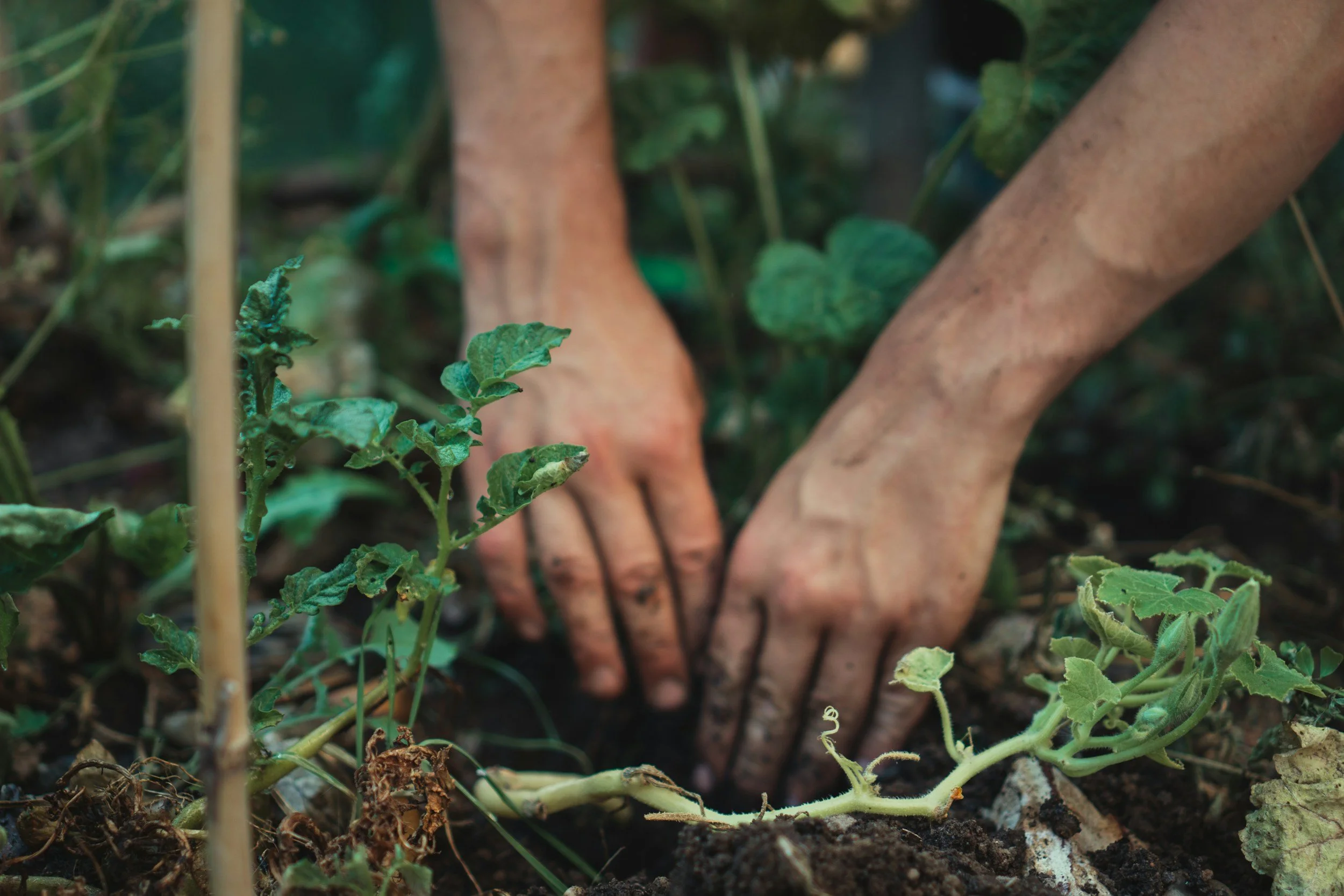
Practice: Go outside. Stand or sit on the earth. Close your eyes and feel the support beneath you. Let your breath deepen. Know: I am held. I am whole. I am enough.
Individuation: A Slow Becoming, Not a Quick Fix
In Jungian terms, the journey of healing isn’t about “getting back to normal”—it’s about becoming more fully who you are. This is individuation: the lifelong path of integrating the conscious and unconscious, the light and shadow, the personal and the collective. Individuation is the becoming, the sprout of spring, the individual aspen trees within the aspen grove.
Becoming is our birthright. Seeds don’t bloom overnight. Spring doesn’t rush— growth is slow, spiral, wise. You don’t need to bounce back. You’re invited to root in.
I find it helpful to ask myself, What part of me is waking up right now? What needs gentle tending rather than fixing? I try to bring this question with me at moments of the day, whether on a walk, between clients, or when I’m stopped at a stoplight in carpool. Just for a moment, this pause, it’s like a little buoy in a busy day.
Shadow Work as Compost
We don’t need to be told that heaviness is part of life. We have experience with grief and the despair that can accompany our feelings of not being supported or seen in ways we need to be. We have to make exceptionally hard decisions that change the course of our lives. And sometimes little mistakes make us second-guess our trajectory in life.
It’s spiritually bypassing to say “everything happens for a reason”—I’m of the mind that that kind of talk is not just dismissive of our pain, it is flat out harmful. Instead, we are entrusted to walk gently—and in relationship—with our pain.
Jung taught that what we push away—our fears, grief, shame—doesn’t disappear. It becomes the Shadow. But what if your shadow isn’t a threat, but a kind of psychic compost? What if what happens—the good, bad, ugly, wonderful—all of it is for transmuting into something else?
Earth wisdom shows us that decay feeds life. What is no longer needed can be transformed into nutrients for the soul. Instead of resisting difficult emotions, what if we sat with them the way the soil receives falling leaves? What if we get the support to do so—and be able to release that which no longer serves us?
Synchronicity & Embodied Connection
Don’t you love coincidences? When you’re thinking of someone, and look at your phone, and they are calling you right now? When you see repeated numbers, over and over? When a cardinal visits you—even in weird or inopportune places?
Jung’s concept of synchronicity— meaningful coincidences that feel deeply personal—reminds us we’re not separate from the world. He highlighted what indigenous and earth-based wisdom traditions always have known—the sacred is the profane, and the profane is sacred. Burnout comes when we find ourselves cut off from this truth.
Nature and our bodies both carry the rhythms of renewal. We know healing, we know transformation. It’s in our bones.
Resilience Isn’t Performance—It’s Participation
Real resilience isn’t about muscling through, it isn’t about exercising more or adding more collagen to your coffee. (For my peri-meno sisters, I see you ;) ). Resilience about re-membering—reconnecting with our bodies, our shadows, the Self, and the sacred web we belong to. You are not separate from the earth’s healing intelligence, because you already have it. I know this for sure—in the dozens of years I’ve worked with folks on their resilience. The work is not about creating it. It is uncovering it.
Re-rooting into your resilience? Need support? Connect here.